5,997 feet (1,838 meters), two railways, one mountain that packs in more than just about any other: the highest church in Germany, a show cave older than the Alps, and a world-class observatory. Here are the ten stops you shouldn't miss, what you'll see, why it's special, and an honest word on what really pays off.
This is no dry audio guide. Almost every stop comes with a short story to listen to, gathered over the years a documentary about the mountain was being filmed, straight from the people who know it best. It's free, and each one runs about two minutes. Listen wherever you like, or take it with you up the mountain.
Here are the ten stops in order, best enjoyed up top with your headphones in, one stop at a time. Most stories are there to listen to, all of them to read.
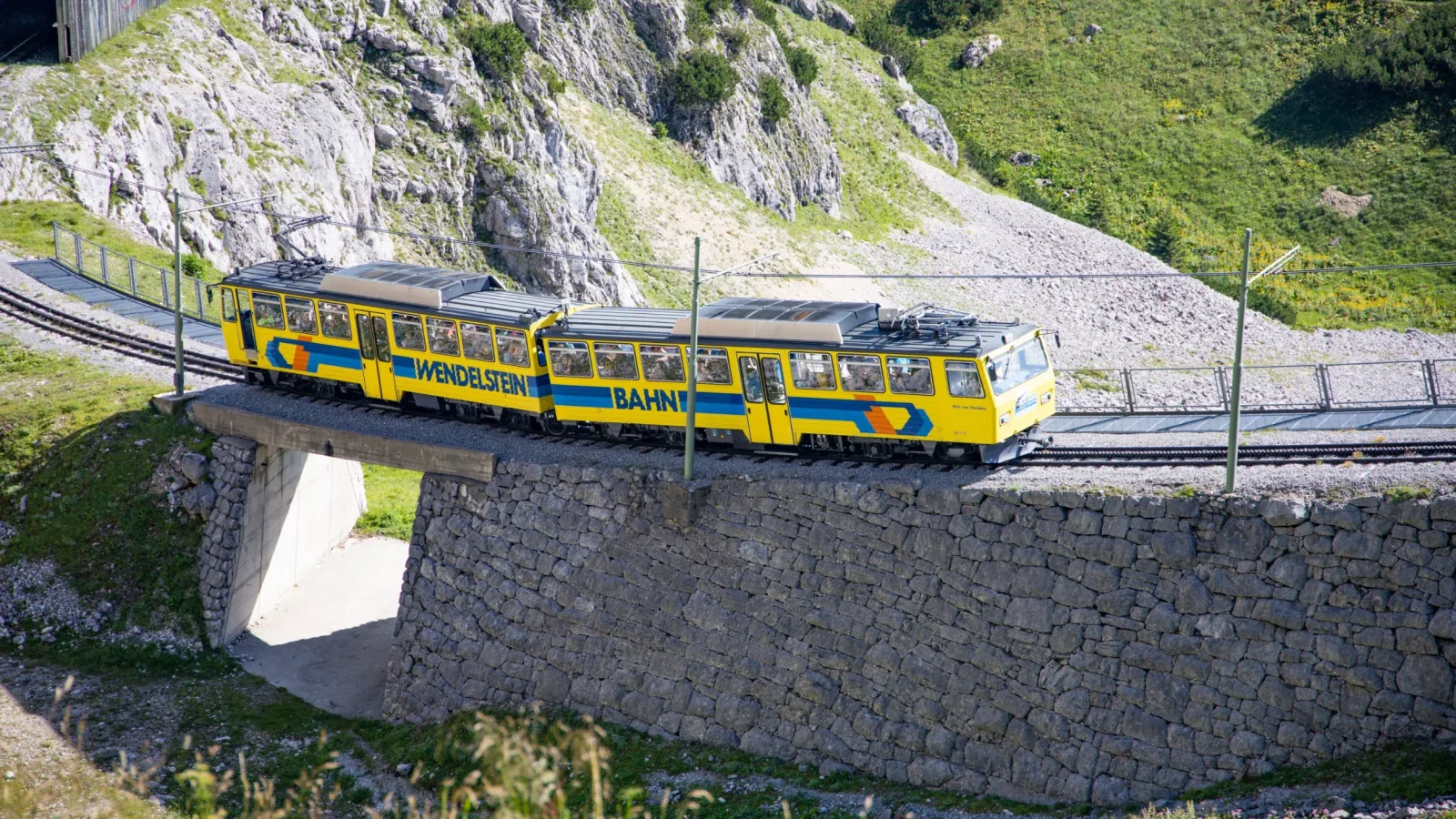
Cog RailwayGermany's first high-mountain railway, running since 1912
Read the story
This railway is a genuine piece of engineering history, and it has been running since 1912. Germany's first high-mountain railway. The idea had been floating around since about 1890, but twice it fell through for lack of money. It was Otto von Steinbeis, a businessman who could see further than most, who finally got it on the rails in 1908, starting from Brannenburg down in the Inn valley. In 1910, Prince Regent Luitpold signed off on the license, and two years later the trains were running.
800 workers, most of them from Italy, Croatia and Dalmatia, carved the line out of the mountain. Every borehole drilled by hand, 35,000 kilos of explosives. Instead of the easier route, they chose the hard one along the steep rock faces, so the railway would stay safe even in winter. Just before the mountain station, you'll spot the most impressive structure of all: the Hohe Mauer, the High Wall.
Steinbeis thought ahead: his railway ran on electricity, fed by its own hydroelectric plant down in the valley. And here's the clever part, the braking energy of the train rolling down the mountain helps drive the one climbing up. Hold on tight, because it's steeper than you'd ever expect from a train. Two original 1912 sets are still running to this day, on special trips and in winter to clear the snow.
Cable Carto the top in seven minutes

Read the story
The fast way up: the cable car from Osterhofen. Seven minutes, more than 3,000 feet (900 meters) of elevation, all of it strung from a single support tower 250 feet (75 meters) tall. Its construction wasn't the spectacle the cog railway's was, but by then it had become a necessity: back in the '60s, the old cog railway simply couldn't keep up with the crowds. In 1969 they started work on the large-cabin aerial tramway.
A tip from people who spend a lot of time up here: skip the fair-weather weekends, because that's when it gets packed. Come on a weekday, catch one of the first cars up, and you'll practically have the mountain to yourself.
And if you have the time, don't take the same line up and back down. The Wendelstein loop lets you ride the cable car up and the cog railway down into the Inn valley, or the other way around, then catch the bus back. That way you get both railways in a single day: the fast, modern one and the historic one from 1912.
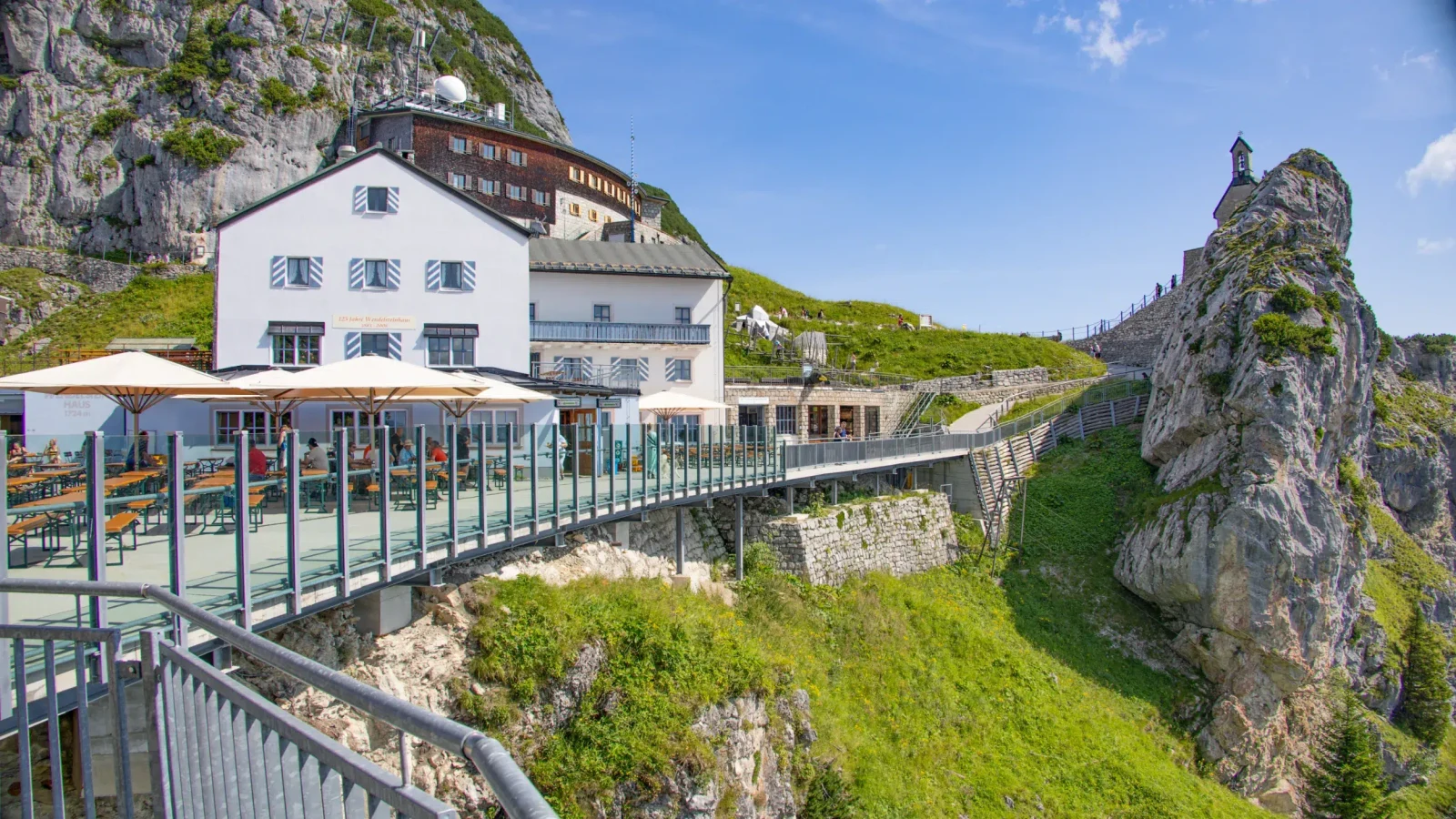
Wendelsteinhausthe oldest mountain lodge in the Bavarian Alps
Read the story
The Wendelsteinhaus is no ordinary mountain inn. It's the oldest year-round lodge in the Bavarian Alps. Behind it stands Max Kleiber, an art professor from Munich. He came up for the dedication of a new summit cross, and the mountain never let go of him again. In 1881 he founded the association, and in 1883 the lodge opened its doors. Without a railway, everything had to be carried up by hand.
You can't stay overnight up here anymore; fire safety rules won't allow it. But what matters has stayed: a place to stop, rest, and take in the view. The mountain terrace has been expanded over the years, like so much up here, carefully, without losing its character. In summer, brass bands from the surrounding villages play, and sometimes alphorn players too.
Here's a good plan: save the lodge for the end. Do the summit, the little church, and the cave first, then settle in on the terrace with a bite to eat and the mountains laid out before you. And a tip most people miss: down in the lower level is the Century Exhibition, and it's free to visit.
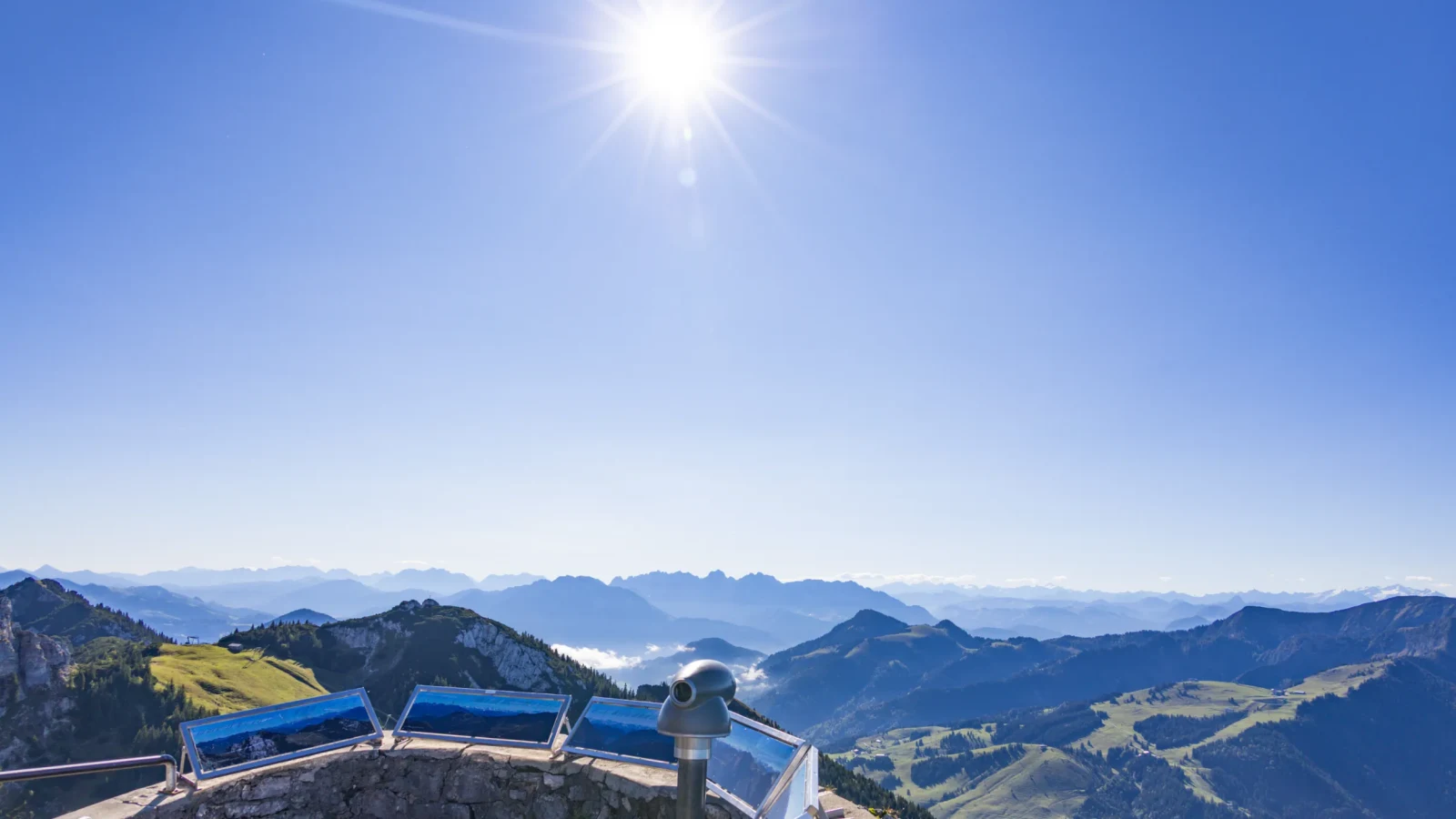
Gacher Blickviews up to 125 miles
Read the story
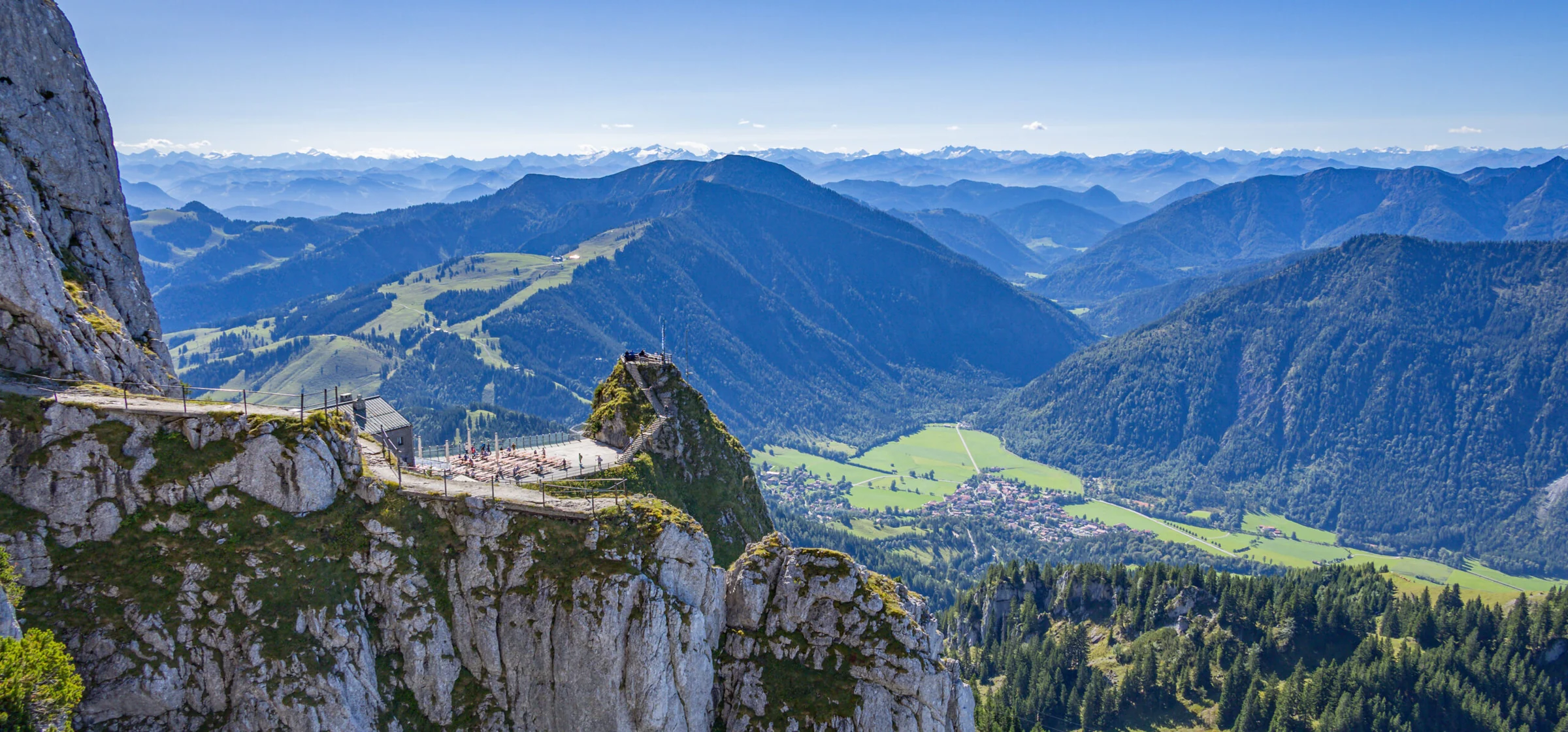
Just a few steps from the Wendelsteinhaus lies the Gacher Blick. Spread out before you is a panorama few other mountains in the region can match: the Wilder Kaiser, the peaks of the Rofan, the Karwendel, the Wetterstein, and beyond them the central Alps with the Grossglockner. On clear days the view reaches up to 125 miles (200 kilometers).
An honest word: people who've stood on top of the Zugspitze and then come here often find the view from the Wendelstein the better one. Higher isn't automatically better.
But the most astonishing thing isn't the distance, it's the age of what's beneath your feet. This rock was a coral reef 230 million years ago, in a warm sea off the coast of Africa. As the earth folded up the Alps, it lifted the Wendelstein along with them. You're standing on a fossilized reef, at 5,997 feet (1,838 meters). Stay a moment longer than you meant to.
Wendelstein Churchthe highest consecrated church in Germany

Read the story
The little church on the Schwaigerwand looks humble, but it carries a big title: the highest consecrated church in Germany, and it has since 1889. Few people understood better why that title doesn't belong to the Zugspitze than Peter Zaggl, who served for many years as the sexton up here and knew this church as well as anyone. He has since passed away, but his explanation lives on: a church needs an altar table consecrated by a bishop, with a relic set inside it. The Zugspitze only has a chapel, not a consecrated altar.
Its beginnings make for a lovely story. The innkeeper up here once complained that the one thing she was missing was being able to get to a church service, since she couldn't come down the whole year. Max Kleiber took it to heart: "Then we'll build a house of worship right here." His association reached all the way to North America. Construction began in 1889, and 14 months later the church stood complete, with materials and bells hauled up by mules and wooden back-frames.
Inside, take a moment for the carved Madonna and the glowing stained-glass windows. And look for the birds in the tree: the species is called a nuthatch, in German a "Kleiber," a little inside joke from the builders. To this day, people are baptized and married here, and Mass is held every Sunday in summer. This is no museum.
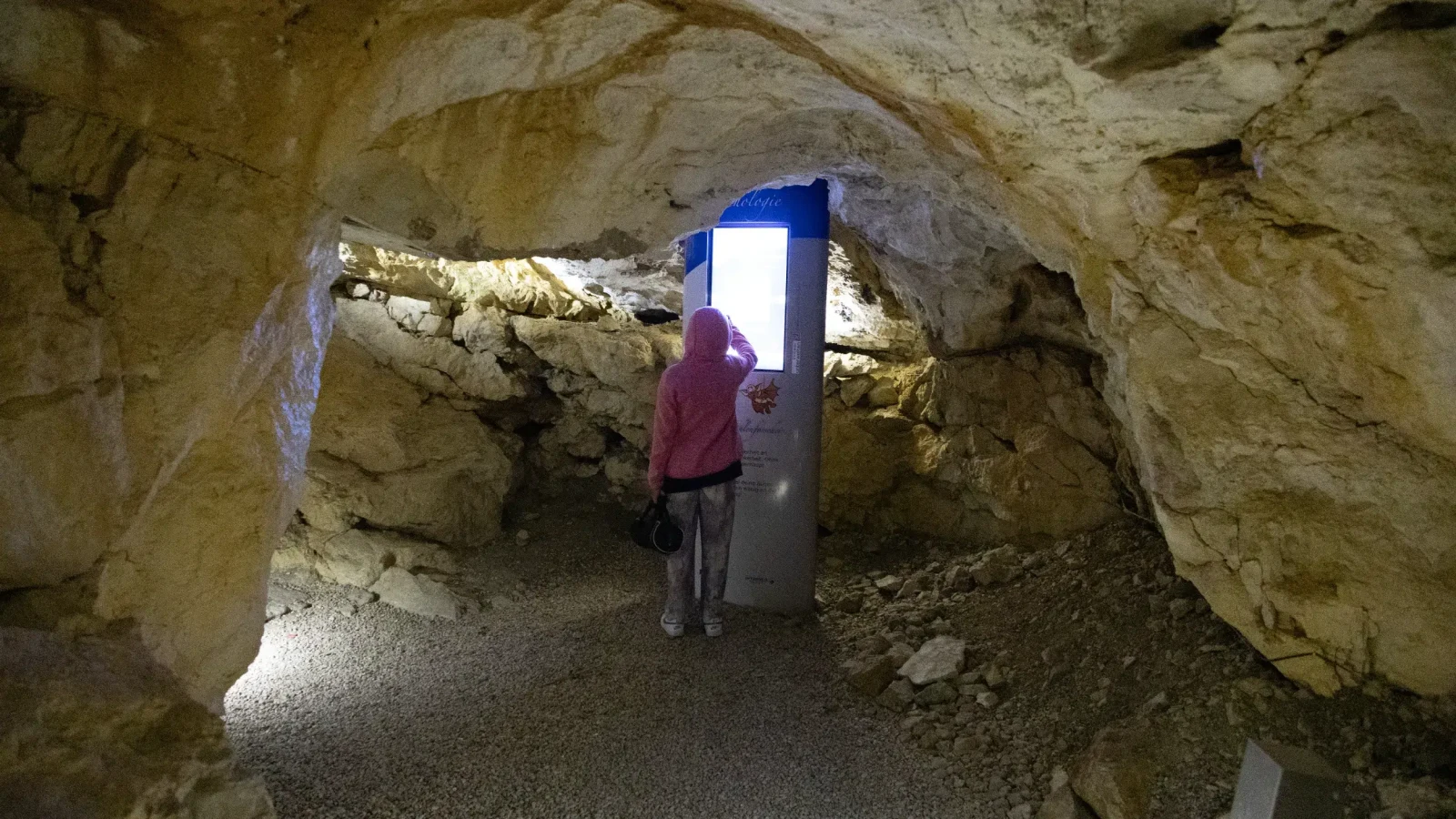
Wendelstein CaveGermany's highest show cave
Read the story
Across from the little church, 82 steps lead down into the Wendelstein Cave, Germany's highest show cave. Let's be clear up front so you know what to expect: this is not a dripstone cave full of glittering formations. It's a fissure cave, a crack in the rock. Geologically, though, it's a sensation, because it was already here before the Alps existed. Older than the mountains all around it. It was discovered in 1864 and first explored by Max Kleiber.
What you see is only a tiny fraction. The entire summit is riddled with a cave system whose full scale has only been mapped on expeditions in recent years: passages you can barely squeeze through, near-vertical shafts. It's the longest cave in the Inn valley.
On a guided tour, say with cave explorer Peter Hofmann, you're in good hands. Going through on your own is another matter: it gets eerie fast, and the tight spots aren't for anyone who struggles with enclosed spaces. It isn't dangerous. But those who push past the hesitation are rewarded: at the natural entrance, snow and ice linger even in summer.
Play Areafor kids, right by the mountain station

BR Transmitterwhere television history was made

Read the story
The red-and-white mast that defines the summit belongs to Bayerischer Rundfunk, the Bavarian broadcaster. It stands 207 feet (63 meters) tall. The mast is up top, but most of the technology sits in the building below it, nearly 330 feet farther down the mountain. Since 1954 this has been Germany's highest backbone transmitter, sending television and radio to almost all of southern Bavaria.
And the mountain was a technical laboratory: fully three years before color television officially launched, test broadcasts were already running up here. They tested stereo sound here from 1970 to 1974, roughly eleven years before it went nationwide.
The appeal lies in the contrast: up top the little church from 1889, an observatory beside it, and in between a piece of technology that brings pictures and sound to millions of people. Hardly any summit brings together so many different things in such a small space. That's exactly what the Wendelstein is all about.
Century Exhibitionfree admission, in the lower level

Read the story
Before you head back down to the valley, the lower level of the Wendelsteinhaus is worth a look: the Century Exhibition. Admission is free, and most people walk right past it. A shame. What's documented here, above all, is the spectacular construction of the cog railway from 1910 to 1912: striking photographs, technical drawings, old tools. After riding up yourself, these images take on a whole different weight.
There's also a film about the history and the sights of the mountain. The Wendelstein has been filmed again and again over the years, and much of what's in this audio guide comes from the making of a documentary shot together with the Wendelstein railway: from conversations with the sexton, the cave explorer, the astronomers. Straight from the source, up here.
The exhibition is small, but it ties together everything you've experienced today, and it explains why this mountain has drawn people from all over the world for more than a hundred years.
Observatoryobserving conditions like Chile

Read the story
The modern dome at the summit is the university observatory of LMU Munich. It began in 1941 with a solar observatory, at first for military purposes. After the war, the Americans handed the station over to the Bavarian state, which attached it to the university.
Why the Wendelstein of all places? The air currents over this summit deliver images as still and sharp as those in Chile or Hawaii, at the very best sites in the world. Since 2012 there's been a two-meter mirror telescope up here, an enormous instrument. It searches for planets around other stars and for dark matter in the Andromeda galaxy.
Through a window you can catch a glimpse of the telescope, though the access is often closed off, and astronomy takes patience: sometimes the weather won't cooperate, sometimes the equipment. But anyone who has spent an evening up here never forgets it: the silence, and down below, the shimmering sea of lights toward the Inn valley and Rosenheim. Across all this time, this mountain hasn't lost an ounce of its magic.
AI-generated narration.